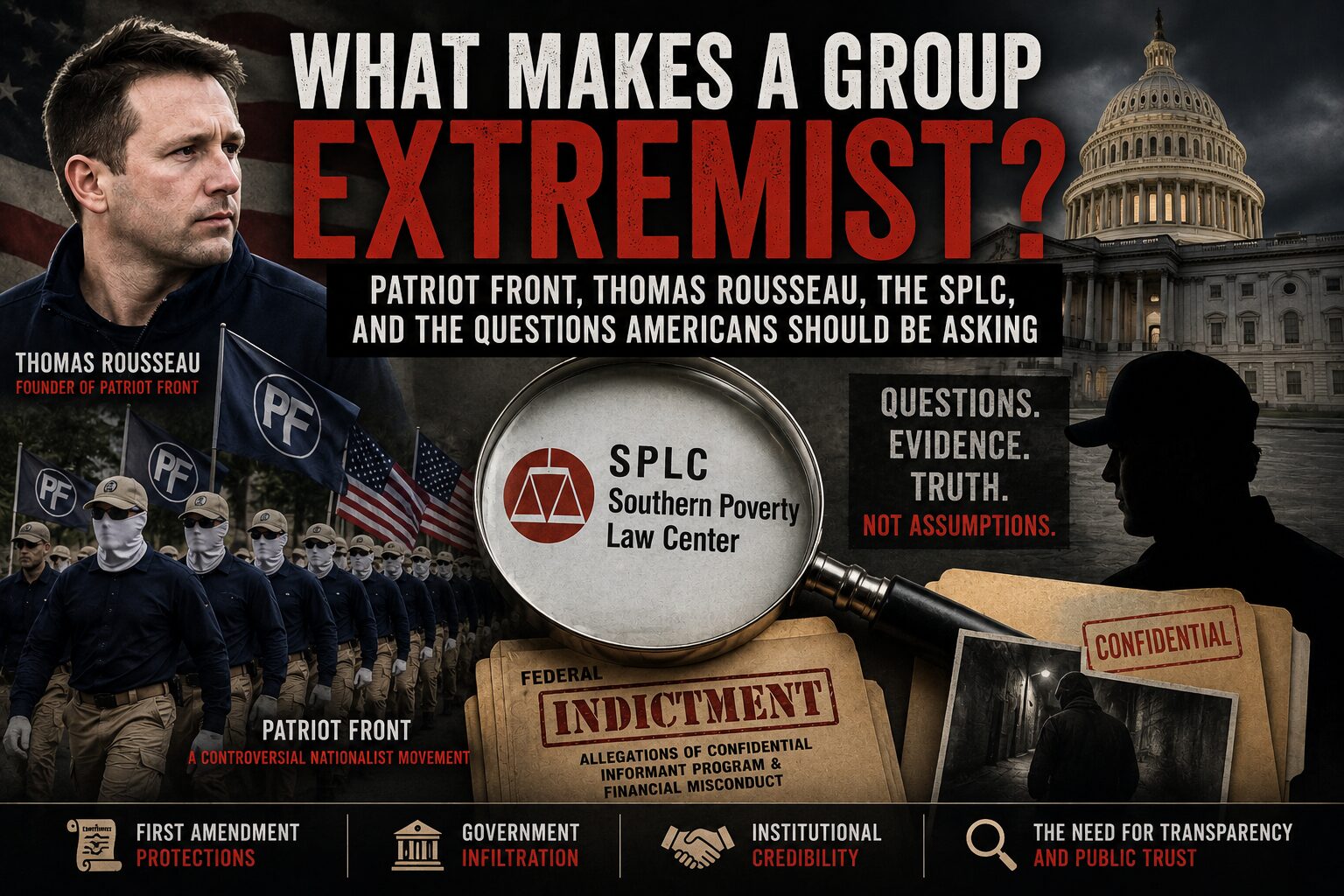
What Makes a Group “Extremist”?
Few words in American politics carry as much weight as the word “extremist.” Once applied, the label can influence elections, employment, banking relationships, fundraising, media coverage, and public policy. Yet many Americans assume there is an official legal definition when, in reality, there is not.
Unlike foreign terrorist organizations, the United States has no federal law that officially designates domestic organizations as extremist. Instead, the term is applied by journalists, advocacy organizations, researchers, and government agencies for analytical purposes. Whether a particular group deserves the label often depends upon the criteria being used.
Some believe ideology alone is enough. Others argue that extremism should be defined by conduct—particularly the advocacy or commission of unlawful violence for political, racial, or ideological purposes. The distinction is significant because the First Amendment protects a broad range of unpopular and offensive speech. American law generally punishes criminal conduct rather than political belief.
Understanding what makes a group extremist requires looking beyond political labels and examining the legal, historical, and factual standards used to classify organizations.
Who Is Thomas Rousseau?
Thomas Rousseau founded Patriot Front in 2017 following the Unite the Right rally in Charlottesville, Virginia. Before creating Patriot Front, Rousseau had been associated with Vanguard America. After Charlottesville, he separated from that organization and formed Patriot Front as an independent movement.
Public reporting consistently identifies Rousseau as the group’s founder and principal leader. Under his leadership, Patriot Front has adopted a disciplined organizational structure, coordinated demonstrations, and carefully managed public messaging that distinguish it from many earlier nationalist organizations. The debate over what makes a group extremist becomes more complicated when examining organizations such as Patriot Front, whose supporters and critics often describe the group in very different terms.
What Is Patriot Front?
Patriot Front has become one of the most visible nationalist organizations operating in the United States. The group is known for organized marches, banner drops, flyer campaigns, and public demonstrations in which members typically wear matching clothing and face coverings.
Organizations such as the Southern Poverty Law Center and the Anti-Defamation League classify Patriot Front as a white nationalist organization. Patriot Front disputes those characterizations and describes itself differently.
Regardless of which characterization one accepts, Patriot Front has become a frequent subject of media attention and public debate.
Who Gets to Decide?
Whenever an organization is described as extremist, Americans should ask a series of important questions. Who applied the label? What standards were used? Were those standards published? Are they applied consistently across different political movements? Is the classification based upon ideology, criminal conduct, or some combination of both?
The SPLC’s Influence
For decades, the Southern Poverty Law Center has been among the most influential organizations monitoring extremist movements in the United States. Its reports are routinely cited by journalists, academics, businesses, and government agencies. Its classifications often shape public understanding of organizations across the political spectrum.
Because the SPLC’s work carries significant influence, its credibility is itself a matter of public importance. Public confidence in any organization that classifies others depends upon transparency, consistent methodology, and public trust.
The Federal Indictment and Questions of Credibility
The recent federal indictment against the SPLC has inevitably raised questions about that credibility. Federal prosecutors allege that the SPLC operated a confidential informant program involving individuals associated with several extremist organizations and that donor funds were used to compensate confidential sources over a period of years. The indictment also alleges financial misconduct relating to aspects of that program.
These allegations remain unproven. The SPLC has denied wrongdoing, pleaded not guilty, and is entitled to the presumption of innocence.
Nevertheless, the indictment presents legitimate questions. If an organization whose mission includes documenting extremist movements is alleged to have maintained confidential sources within some of those movements, the public is entitled to ask how extensive the alleged program was, what oversight governed it, and whether those activities affected public reporting or donor transparency.
The indictment is equally important for what it does not allege. It does not identify Patriot Front by name. It does not allege that the SPLC funded Patriot Front. It does not allege that Patriot Front participated in the alleged confidential informant program. Those distinctions matter because responsible public discussion should remain grounded in the allegations actually contained in the charging document.
Government Informants, Infiltration, and Public Skepticism
One reason many Americans are skeptical of modern extremist organizations is history. Federal and state law enforcement agencies have long relied upon confidential informants and undercover operatives to investigate organized crime, terrorist organizations, violent gangs, and extremist movements across the political spectrum.
In some investigations, informants merely observed criminal activity. In others, they attended meetings, recruited members, participated in planning discussions, or occupied leadership positions. Those historical examples have shaped public perception and led many citizens to ask whether confidential informants may also have operated within more recent organizations.
That history naturally gives rise to broader questions. If confidential informants were present inside certain organizations, how much influence did they have? Did they merely report criminal activity, or did they encourage it? At what point does infiltration become participation? These are longstanding questions that have been debated in courts, Congress, and academic literature for decades.
Those questions should not be confused with evidence that any particular organization is controlled by the government. Public skepticism is understandable given the history of undercover operations, but suspicion alone is not proof. Every claim should ultimately be evaluated on the basis of evidence rather than assumption.
What We Know—and What We Don’t Know
There are facts established by the public record. Patriot Front was founded by Thomas Rousseau after Charlottesville. The SPLC has classified Patriot Front as a white nationalist organization. Federal prosecutors have returned an indictment alleging that the SPLC maintained a confidential informant program involving individuals associated with several extremist organizations. The SPLC has denied those allegations and the case remains pending.
There are also questions the public record does not presently answer.
Were any confidential sources associated with organizations that later evolved into Patriot Front?
Will future court filings identify additional organizations or individuals?
Will discovery reveal the scope of the alleged informant program?
How should the indictment affect public confidence in one of the country’s most influential organizations monitoring extremism while the criminal case is pending?
Those questions remain unanswered.
Why These Questions Matter
Ultimately, this discussion extends far beyond Patriot Front or the Southern Poverty Law Center. It concerns how a free society defines extremism, how influential organizations earn and maintain public trust, and how citizens distinguish between established facts, disputed allegations, and speculation.
The implications of labeling a group as extremist extend beyond individual organizations and touch upon the broader societal framework that shapes our understanding of extremism. This raises critical questions regarding the criteria used to define extremism and the processes through which organizations like the SPLC gain societal legitimacy. As the judicial proceedings unfold, it is essential to uphold the principle that any determinations regarding extremism must be grounded in verifiable evidence, ensuring that public discourse remains informed and balanced amid ongoing controversies. The outcomes of these discussions will ultimately influence the perception of not only the SPLC but also the mechanisms of accountability within civil society.

Author: John Q. Public
Citizen: AI-art Monger, Cognitive Dissonance Purveyor, Ant pile kicker, Antagonist, Confabulist, Artist, Truth Spreader, World Traveler, Captain, Scholar, J.D.